Getting Social...With a Virtual Homo Sapien?
Monday, November 16, 2009
Getting Social...With a Virtual Homo Sapien?
Penguins and Sea Lions Help Produce New Atlas
By Samuel Mann
Atlases are usually made and used by people for navigation in parts of the world. They provide accurate information on latitudes, longitudes, water features like lakes and shorelines and terrain features like mountains and valleys that are important for pilots, sailors, or even simple hikers. What you wouldn't expect from an atlas is that is was not made by humans (so-to-speak). The Wildlife Conservation Society (WCS) and BirdLife International have released a new atlas of the Patagonian sea using data that was collected from 16 species of marine animals and produced 280,000 data entries! The Patagonian Sea is a huge body of water from southern Brazil to southern Chile.
The atlas contains the most accurate maps ever assembled for this ecosystem revealing key migratory corridors that span from coastlines to deep-sea feeding areas off the continental shelf hundreds of miles away. The project took 25 scientists 10 years to complete! The list of species tracked for the atlas includes five species of albatross, three species of petrel, four varieties of penguin, two fur seal species, the South American sea lion, and the southern elephant seal.
The significance of this new atlas is that not only was it written by the wildlife that inhabit the area, but it also records marine animal migrations and breeding patters that are important to take into consideration for conservation. This data will be important for managing fisheries and routes for oil tankers that protect important habitats for the marine animals. Conservation is an ever growing concern in life due to the degradation of the ecosystem. What better to preserve the ecosystem than to know just which habitats are the most crucial? This way mariners can plot courses through waters that aren't as vital or fragile.
I think that it is really creative to use the animals that live in an area to plot the land features such as deep water and shorelines. Various animal behaviors require that they travel to certain land features such as deep water feeding, coastal nesting, or perhaps breed grounds. Using GPS on marine animals not only shows their behavioral patterns but also maps out certain geographic features of previously unknown or unfamiliar locations. I think it is ingenious.
Monday, October 19, 2009
Geneticists Use DNA to Diagnose Patient
This could change medicine forever. Doctors don't have to fit together a puzzle of symptoms and tests to guess at a disease. Instead, they can almost literally take a picture of the patient's DNA and know for sure what's wrong with them. Unfortunately, not all diseases can be found in DNA, only some of the genetic ones. Although limited, this has a lot of potential as well.
This article impressed me, I didn't know it was practical or eve possible to use DNA to diagnose patients. I'm interested to see how this will be implemented into medicine, and how far it could go. They also saved a lot of money by just analyzing the protein parts, which could help a lot of people.
Monday, October 12, 2009
Weather Effects Walruses?
October 12, 2009
Physics
Science in the News: http://dotearth.blogs.nytimes.com/2009/10/02/on-walruses-and-warming/
Weather Effects Walruses?
As the whole world freaks out about global warming and what it is doing to the penguins and Indian tribes of the arctic, no one lends a thought to the Pacific Walrus. As the ice caps melt on the water, the walruses, along with polar bears and other arctic creatures, crowd together on the small pieces of land. While, it is obviously not good for the walruses to be on the land to start with, the huge crowds make the land a tight squeeze. When all the walruses are packed into such a small space, entering the water to hunt can be extremely hard for them. What commonly happens is that once one walrus makes its way to the water, another follows, then another, then another, and next thing you know there is a huge stampede of walruses rolling down the side of a hill.
The ice caps melting has been a huge debate ever since Al Gore released “An Inconvient Truth.” Some people blame it on people and work to reduce their carbon footprint, while others claim it is just a flux in the weather and the earth will figure it out on its own. One of the biggest problems with the walrus stampedes is the death toll. Too many walruses cannot make it into the water fast enough on the land and are crushed under the weight of the other walruses. The Pacific Walrus was just recently relieved from major hunting pressures and there are not as many of them alive as there should be. The extinction or endangerment of the Pacific Walrus would be horrible for the world’s ecosystem, as is the extinction of any other species.
At first I was quite amused by this article. It seemed like a slightly ridiculous article until I read it. It is actually a very important issue relating to climate change that I had never thought of before. It made me realize that more than just the polar bears are affected by this issue and that many other species could be affected.
The Shell Super Ship
Although a final decision has not been reached, the oil company Shell is considering purchasing the largest ship ever built. At 600,000 metric tons and 480 meters long, it is nearly 3 times the mass of the world’s largest passenger ship. The reason for building this will be to reach oil fields that used to be too far out to sea to access. It size will also allow it to pass through extreme weather, such as typhoons unaffected. As of now, oil platforms are not mobile, and as such, become obsolete when their oil fields run dry. This ship however, could simply move to another site.
This could have an impact on peoples’ lives in an indirect way. While most would never see it, they could unknowingly pump their car full of gas that was reached using this ship. If we were able to reach new oil fields, it could also reduce the price of gasoline, which everyone would notice.
I have mixed feelings about this news. On one hand, I am always excited about new engineering marvels and new ways of doing things. On the other, would rather see the money being spent on this go to alternative fuels so we wouldn’t be using up a limited resource and polluting our atmosphere.
http://www.popsci.com/science/article/2009-10/shells-megaships-will-dwarf-everything-high-seas
New Strategy For Mending Broken Hearts?
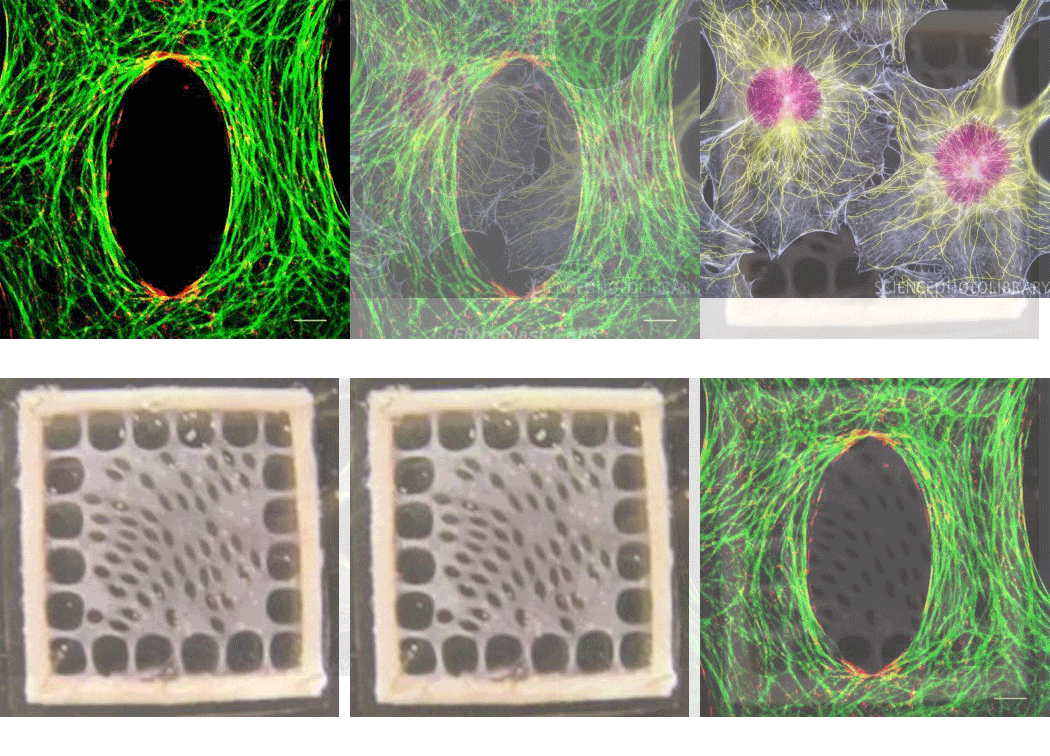
Bioengineers have just discovered how to grow heart tissue made of heart muscle cells called cardiomyocytes. The biomedical engineers at Duke's Pratt School of Engineering have created a "patch" of heart tissue that exhibits the two most important attributes of heart muscle cells; the ability to contract and to conduct electrical impulses. Mouse embryonic stem cells were used in the bioengineering project and this is an important first step to growing living, working heart tissues.
The researches grew cells in an environment much like that found in natural tissues. They used a gel composed of blood-clotting proteins to strengthen the cells and allow them to form a three dimensional structure. Additionally, the researches also found that the cardiomyocytes grew best only when "helper" cells, known as cardiac fibroblasts, were also present. The cardiac fibroblasts are present in 60% of all cells in the human heart and thus allow the heart cells to grow correctly. When tested, the cardiomyocytes were oriented properly by the cardiac fibroblasts and were thus able to contract like normal heart muscles. While this is a step in the right direction, progress still needs to be made to create blood vessels that can sustain the tissue. Hopefully these patches of heart muscles can be produced in large amounts quickly enough to be used for therapeutic restoration of damaged heart tissues due to disease and heart attacks.
Whether people love the ethics of it or not, stem cells are the future of medicine. Over the decades medicine has progressed to smaller and smaller levels within the human body. Inoculations were the first microscopic application of medicine into humans. Antibiotics, penicillin, and blood transfusions took science into the blood and tissues of our bodies. Now, stem cells can take us even deeper to combat diseases that affect us down to our very cell structures. I think the most amazing, and somewhat beautiful, part of stem cell research is that scientists actually use human-made cells. Stem cells aren't some sort of genetic product. Rather, stem cells occur naturally as a vital aspect of human development and growth. Stem cells are meant to be used to create all the cells in the human body and now scientists are beginning to harness these amazing cells to create tissues needed to fight disease. The possible benefits of stem cells and biomedical engineering seem endless and are opening new doors of science and medicine. A whole new era of medical technology is being born right now.
I am very excited about this article. For one, it is really cool. Scientists are actually growing working heart muscles! How cool is that?! I bet I will be alive to see the first fully functional human heart be made by scientists. Second, listen to the title, "Biomedical Engineering." Doesn't it just send shivers down your spine at the sound of its auspicious and high-tech name? Remember when heart transplants were the cool thing? Well now it's bioengineering. Not only am I taking AP Biology this year in high school, but I am also thinking of a career in the medical field. I was thinking about radiology, and still am, but this article has opened my mind and imagination to the possibilities of being a bioengineer.
P.S. I made that GIF. XD
Works Cited:
Duke University. "New Strategy For Mending Broken Hearts?." ScienceDaily 12 October 2009. 12 October 2009
Images:
http://www.immediart.com/catalog/images/big_images/SPL_6_P780110-Fibroblast_cells_showing_cytoskeleton.jpg
http://machineslikeus.com/files/imagecache/captioned_image/NLN/17273_rel.jpg
http://www.sciencedaily.com/images/2009/10/091011184432-large.jpg
Saturday, October 10, 2009
Riding on Through